


Leadership Under Permanent Pressure
The Results
What began as the exception has become the norm
After five years of permacrisis, the state of emergency has become everyday life at the top. Pandemic, supply chain disruptions, energy price shocks, geopolitical instability and a pace of transformation that remains high. For many executives, a series of individual crises has become a permanent condition.
Führungskräfte berichten häufiger Termin- und Leistungsdruck als Beschäftigte ohne Führungsverantwortung und arbeiten häufiger an der Grenze ihrer Leistungsfähigkeit. 71 % derer, die häufig an dieser Grenze arbeiten, berichten drei oder mehr psychosomatische Beschwerden.
Nur 40 % der Führungskräfte erhielten im vergangenen Jahr ein Coaching zu ihrer Führungsaufgabe. Nur 10 % der Beschäftigten sind emotional hoch gebunden, 77 % machen Dienst nach Vorschrift.
62 % der Führungskräfte denken über einen Wechsel nach, Rekordwert seit Beginn der Messung 2015.
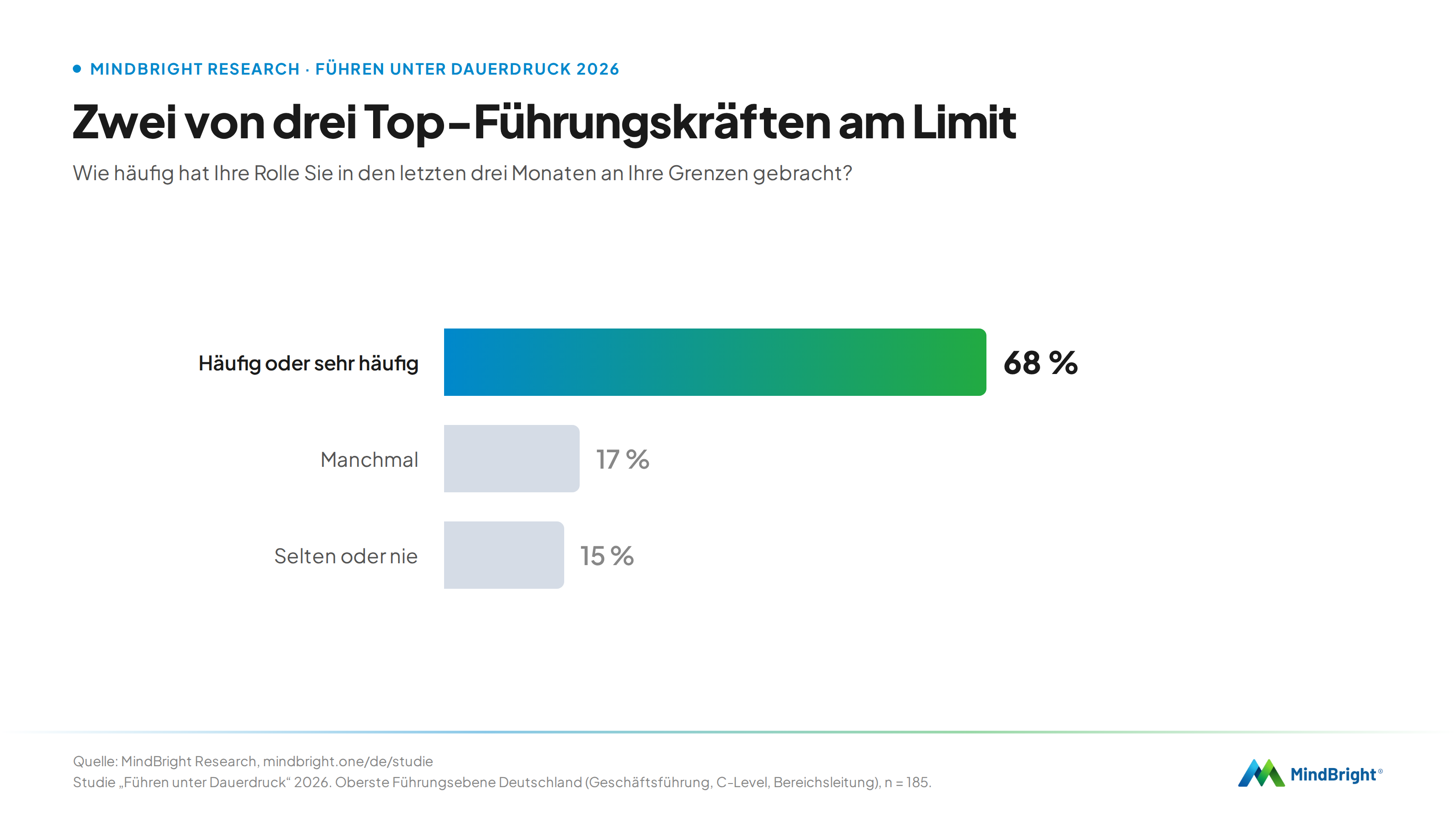
Two in three top executives frequently reach their limits.
Finding 3
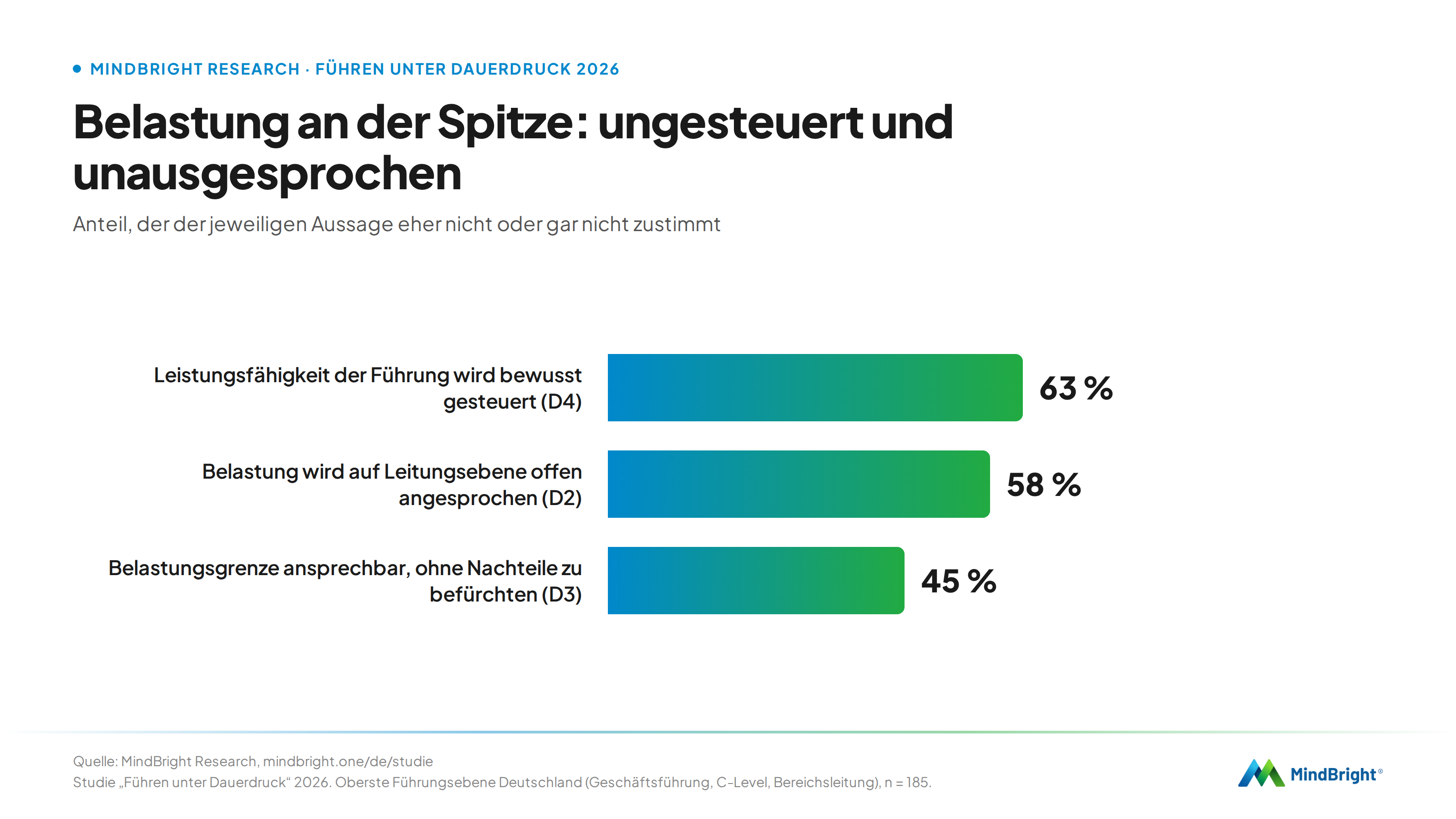
Leadership capacity goes unmanaged.
Only 12 percent say their company manages the performance of its leadership as deliberately as other key corporate resources. 45 percent fear career disadvantages if they openly say they have reached their limit. Only 28 percent have ever used their company's support offers.
Hypotheses
Self-reports, correlations, no causality.
Whether routines hold under pressure does not depend on the level of strain (rho -0.01, CI [-0.18; 0.14]).
Where support offers and a known contact person exist, executives feel safer raising strain (rho 0.67 and 0.68, together R² = 0.51, strongest relationship in the study).
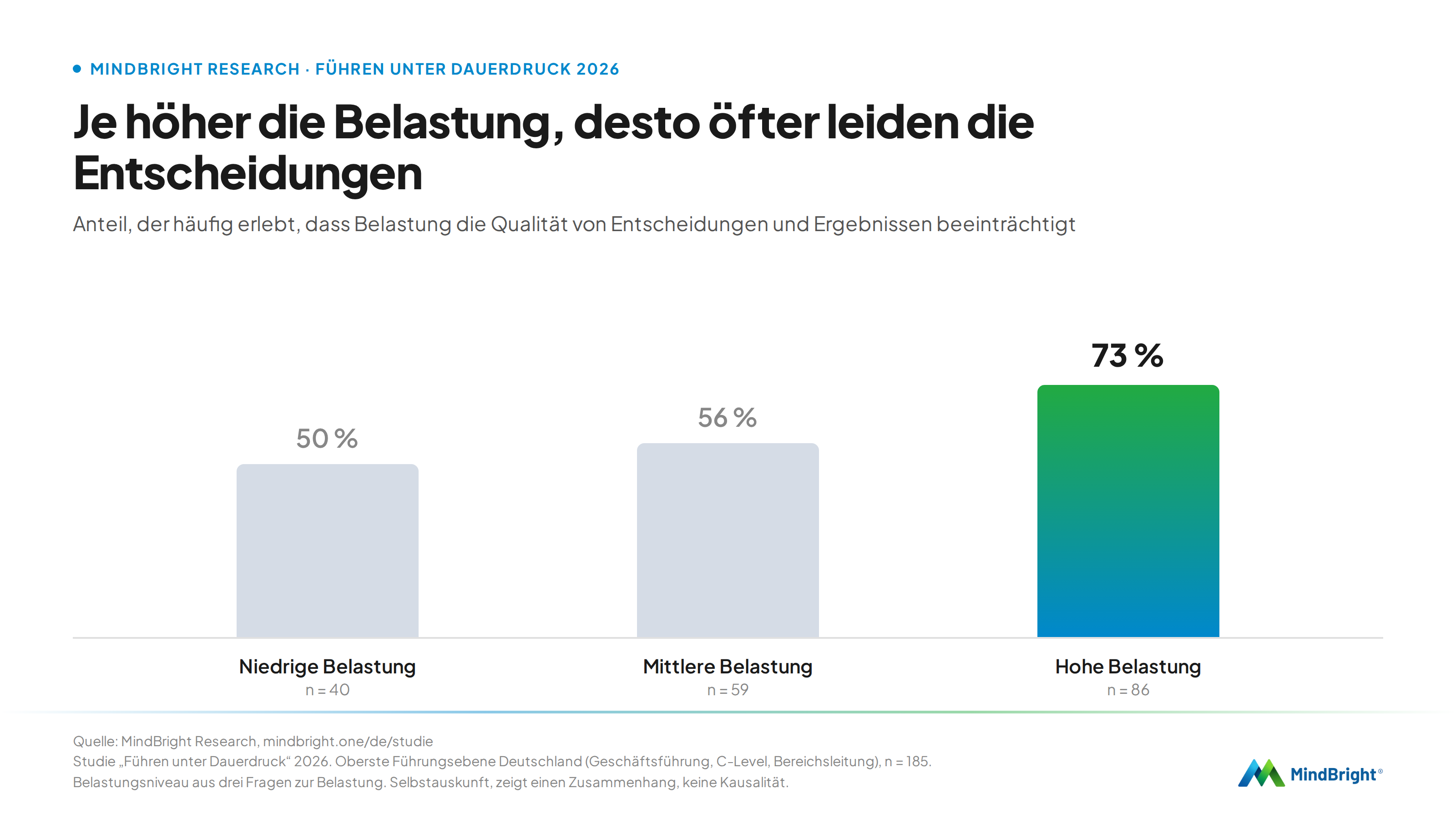
The higher the strain, the more often decisions and work on the future suffer (rho 0.27 for decisions, 0.22 for work on the future).
The Report
Summary Report
Free to download
Key findings, the concept of leadership capacity, three hypotheses, methodology and deviations on five pages.
Download summaryFull Report
All findings in depth
Findings with charts, recommendations with rationale, all 27 questions and sub-groups. Receive the full report by email.
Methodology and Limits
Anonymous online survey on mindbright.one from 14 August to 25 September 2026, 27 closed questions. 222 qualified responses, 204 from Germany and 185 from top management (managing directors or board members 79, C-level 57, division heads 49). Team and department heads in Germany (19) and responses from Austria and Switzerland (18) are reported separately and do not enter the core findings. The responses to the optional open question are not evaluated in this report.
Preregistered at OSF on 19 August 2026: doi.org/10.17605/OSF.IO/KQA23. Hypotheses and analysis plan are archived there.
The sample is not representative and was recruited via personal networks and multipliers, without a panel. It is younger than top management overall (23 percent under 35) and strongly shaped by the Mittelstand (43 percent from companies with fewer than 250 employees). All data are self-reports. The relationships are correlations and do not allow conclusions about cause and effect. The items were developed specifically for this study and are not validated scales.
Deviations from preregistration
(1) Fieldwork closed on a fixed date, 25 September 2026, instead of the registered stopping rule; the date was set before any review of the responses. (2) 30 responses from 14 to 18 August 2026 were received before registration and are included; 27 of them come from top management in Germany; without them (n = 158) the findings are unchanged.
For Media
Free for editorial use. Source: MindBright Research, mindbright.one/de/studie, online with a link to the study.
Frequently Asked Questions
MindBright Research, die empirische Publikationslinie von MindBright. Die Studie wird transparent von Maik Oliver Ludewig, Mag., initiiert und geleitet; Methodik, Fragebogen und Grenzen der Stichprobe werden vollständig offengelegt.